
Language Access Needs Assessment Report
Report from a study of a Language Assistance Plan instituted by CRI-Help, a premier provider that helps treat substance use.
LANGUAGE ASSISTANCE PLAN
For CRI-Help CRI-Help
Preceptor: Baldomero “Junie” Gonzalez
Prepared By: Som Chivukula UCLA, MHA candidate 2025
Table of Contents
1) Executive Summary – Page 4
2) Background – Page 5
3) Problem Overview – Page 6
4) Literature Review – Page 7
5) Methodologies – Needs Assessment – Page 8
6) Methodologies – Benchmarking – Page 8
7) Methodologies – Qualitative data analysis – Pages 9 - 10
8) Methodologies - Quantitative data analysis – Page 10
9) Methodologies – SWOT – Page 12
10) Findings – Page 13
11) Recommendations – Pages 13 - 15
12) Conclusion & Next Steps – Page 15
13) References – Pages 16 - 17
Executive Summary
Background: Census data in Los Angeles shows that nearly one in three residents possess Limited English Proficiency (LEP) [CMS, 2022]. Effective communication is essential for them to access the services they need. A complex treatment regimen, such as the one for substance abuse, is made even harder by the language barrier. It is essential that providers have a Language Assistance Program (LAP) to help these patients access the services they need. Local, state, and federal laws also play a role, requiring providers to have an LAP.
Objective: The objective of this study is to help institute a Language Assistance Plan for CRI-Help, a premier provider that helps treat substance use. CRI-Help has helped over 40,000 patients in Los Angeles since its inception in 1971. Management can use this study to understand its options and decide what best serves its needs.
Approach: The approach taken for this study involves needs assessment, benchmarking,
qualitative data analysis, quantitative data analysis, and SWOT. Each of these provides different insights into the unique situation CRI-Help finds itself in.
Assessment: The needs assessment, benchmarking, qualitative and quantitative analysis, and SWOT shows the possible choices for CRI-Help from an external perspective such as the one I am providing. These are not the only factors that CRI-Help would need to consider when making its final decision.
Recommendations: I am proposing four solutions over three-time horizons (small, medium, and long). These solutions are—do nothing, digital tools, have a part-time human translator, and a full-time translator.
Background
According to census data, in Los Angeles County nearly one in three residents are limited English speakers and over 800,000 are deaf or hard of hearing [CMS, 2022]. Effective communication is essential for these individuals who may or may not need substance abuse disorder services. In 2016, the Centers for Medicare & Medicaid Services made it a requirement for providers to have access to quality language assistance services for individuals with Limited English Proficiency (LEP) [CMS 2016].
In addition, there are several intertwining local, state, and national laws that providers need to comply with, which makes a Language Assistance Plan (LAP) crucial. Having an LAP in place also will help one Los Angeles-based provider, CRI-Help, attract new clientele who can access the necessary treatment options they need for rehabilitation from drugs and alcohol. CRI-Help has annual revenues of $30 million and a staff of over 250 people. Founded in 1971, CRI-Help is a premier provider of treatments for substance abuse. The organization has treated over 40,000 people since its inception, creating a legacy in the Los Angeles area. Many clients
have provided superlative feedback for CRI-Help’s methodologies, and some have even said “miracles happen here.” The organization’s values – compassion, community, integrity, and care – resonate throughout its facilities. CRI-Help serves nearly 1,000 patients annually at its various facilities, with most patients being native English language speakers. A small minority – about 12 percent – are patients who speak
Spanish. To meet the needs of Spanish speakers, CRI-Help provides care through its certified bilingual staff. “We recognize that cultural and spiritual diversity are critical components to providing respectful and individualized services. Incorporating culturally unique traditions, holidays, and culinary options improves the quality of care for our clients,” CRI-Help’s website states. Its management estimates that around one percent of its patient population are speakers of other languages.
Within Los Angeles, a dynamic melting pot of global cultures, the county has identified 13
threshold languages: Arabic, Armenian, Cambodian, Cantonese, English, Farsi, Korean,
Mandarin, Other Chinese, Russian, Spanish, Tagalog, and Vietnamese [LACounty.gov]. Of these, the primary languages that the one percent of CRI-Help clientele speak are Armenian, Farsi, and Russian.
The following table from the LA County Department of Mental Health shows the service areas and languages spoken [LACDMH, 2018].
The service areas in numerical sequence are Antelope Valley, San Fernando Valley, San Gabriel
Valley, Metro L.A., West L.A., South L.A., East L.A., and South Bay.
Problem Overview and Objective
It is important to recognize and address language barriers so that all individuals receive the proper care they may need to treat substance use. Implementing a proper LAP plan will enable CRI-Help to expand its reach to a community that it might not already be reaching. Although LAP services are extensive (document and language translation, American Sign Language interpretation, etc.), it is crucial to understand the specific needs and constraints of the organization to focus on the most helpful service. The organization has two primary
locations – the George Pfleger Center in North Hollywood, and the Socorro Residential
Treatment Center in Los Angeles. The Socorro center’s staff is bilingual, and they can tend to
their Spanish-speaking clientele. A third location, Lincoln Heights Recovery Campus, is set to open in 2025 [CRI-Help website]. Each of these locations will have its specific needs and it is vital to provide a customized solution. A solution would also account for inpatient and outpatient services because inpatient treatments take place throughout the day and in group settings, and outpatient services are during business hours that stretch to 9:00 pm.
But with a problem that potentially impacts only a tiny portion of its clientele (one percent, per management estimates), CRI-Help is not able to devote significant resources – operational or financial – to address this problem. Indeed, the only need here is one of compliance so that the regulatory bodies are satisfied, and contracts with CMS are found to be in good standing.
Therefore, any proposed solution will need to consider these constraints and provide a solution over various time horizons that maximizes the service provided and builds the organization’s client base. The aim of this study is to provide an independent, external, perspective that helps management decide on the best course of action as it plans its strategy on a Language Assistance Program.
Literature Review
As I noted earlier, Language Assistance Plans are important for those who possess Limited
English Proficiency. There is a dearth of scholarly literature on this topic, especially as it relates to healthcare. Some of the literature focuses on the lack of adoption of language assistance services even when the service is provided due to lack of awareness or individual comfort [Shamsi, 2020]. The following literature is intended to educate the reader on the importance of this topic and support the analysis, findings, and recommendations that follow. “Should the language you speak determine how long you live?” This salient question is posed by Mara Youdelman in a 2008 Health Affairs article. There are dozens of federal and state laws, and the lack of implementation that prevents limited English proficiency people to get adequate care. “Many providers remain unaware of how to comply with Title VI, and their lack of knowledge of state laws is even greater. Thus, it falls to both federal and state regulators to educate health care providers and provide technical assistance and resources for implementation,” she wrote.
As of 2008, the state of California has over 150 laws that prevent discrimination in any state funded activity or receive funding from the state. Youdelman also states other pertinent issues when it comes to LAP: training for healthcare providers, facility licensure, interpreter competency, English-only laws that require all state activities to take place in English, implementation and enforcement, funding, and accountability.
In a 2010 Science Direct article, Atil Ginde and other researchers share their findings on the use of professional interpreters in the ED department in Boston. The results were not pretty: The use of professional interpreters by Boston ED patients with language barriers remained low despite publicity of the mandatory state interpreter law. Patients were comfortable using a friend or family member in the clinical setting, which might contribute to the limited use of professional interpreters.
In a 2020 study in the Journal of Immigrant and Minority Health, researcher Breena Taira and others find that language assistance usage is underutilized. Researchers found ED providers and staff had little training in the use of language assistance and were unaware of hospital policy.
Methodologies
To get a holistic view of internal and external dynamics, I decided on the following
methodologies for this project: needs assessment, benchmarking, qualitative data analysis (leadership interviews and client focus group), quantitative data analysis (contribution margin and breakeven), and SWOT.
Each of these data sets sheds light on the opportunities and constraints of the organization and helped me craft a solution that especially considers the constraints.
Methodology: Needs Assessment
The needs assessment (artifact 1) is a questionnaire that asks Who, What, When, Where, and Why. The needs assessment was required to learn about the organization since I am an outsider [HHS, n.d.].
CRI-Help has a capable Spanish-speaking staff to help LEPs who speak Spanish. Flyers are placed at the reception area for patients who may need an interpreter. The organization needs staff to translate documents to Armenian and Farsi from English.
Methodology: Benchmarking
Benchmarking is the process of measuring products or services compared to the competition or industry leaders [ASQ, n.d.]. This process provides insights into how one organization compares with another. Two primary forms of benchmarking exist – technical benchmarking and competitive benchmarking. Technical benchmarking is used to determine the capabilities of products or services, especially in comparison to the products or services of leading competitors.
Competitive benchmarking compares how well (or poorly) an organization is doing with respect to the leading competition. For this project, there are three organizations that have implemented Language Access Plans
that can be used as a competitive benchmark.
California Department of State Hospitals (DSH): The DSH reviewed its programs and services that are offered to the public to implement a Language Access Plan, which was mandated by the California Health and Human Services Agency in June 2023. In addition, the agency reviewed how it communicated to the public, the constituents it served, and the information provided in
languages other than English. DSH notifies the public of languages by:
1) Posting “I speak” cards
2) Translated notices in waiting areas in threshold languages
3) Translated taglines on department program websites
4) Patient admission when the treatment team assesses the language barrier and is documented
Patients who have limited English proficiency (LEP) can contact the hospital operator, who can connect to the hospital’s primary point of contact to facilitate language access through certified bilingual staff or contracted interpreter services. Staff members are trained on how to access bilingual staff or interpreting services. DSH contracts with several vendors that provide on demand telephone or video interpreting services. Onsite translators are provided as needed.
DSH has an internal workgroup to support the identification and translation of vital documents [DSH, n.d.].
Substance Abuse and Mental Health Services Administration [SAMHSA.gov, n.d.]: The
organization takes steps to inform the public that translation services are available at no cost to them. It conducts an annual assessment to review and update its policies to provide language assistance plans. SAMHSA also trains its employees on the organization’s responsibilities related to providing language assistance for LEP customers. Los Angeles County Department of Public Social Services [DPSS.LACounty.gov, n.d.]: The department has 18 translators on staff who are certified bilinguals to aid LEP customers. In addition to using contracted vendors, the department has access to community members and stakeholders to address any unforeseen needs. These competitive benchmarks provide insights into how organizations have implemented LAP.
It is crucial to remember that these are larger government entities rather than CRI-Help’s
competitors. Yet, CRI-Help can institute similar plans on a lower scale to ensure compliance. For example, it is not feasible to hire 20 translators in a short period but that could be a longer-term goal for the organization.
In addition to the above organizations, I called half a dozen other substance treatment
providers, but they did not get back to me after repeated calls and e-mails. Their websites did not have information about language assistance plans.
Methodology: Data Analysis – Qualitative
For this study, qualitative data analysis involved leadership interviews, and a client focus group. Both were very revealing, but from different facets. The focus group showed the importance of having someone speak their language when dealing with a professional who spoke in English. “If I can’t say what I need, I just stop talking. I don’t want to feel kind of like embarrassed or like
no one understands me, so sometimes I don’t ask for help. That doesn’t really happen to me when I’m speaking my language. So, I think I’d feel more comfortable and supported,” one patient said.
The biggest takeaway from the focus group was that these patients were going through a rough patch in their lives; and, having somebody they could connect with, especially linguistically, would make all the difference to them as they sought treatment. The leadership interviews were with frontline members who work with patients. This portion showed the flip side, from the view of the provider. “First, it communicates that we care about their needs and are committed to providing accessible, patient-centered care. Second, it conveys respect for their language and cultural background, fostering a more inclusive and supportive treatment environment,” one person observed.
There were some concerns about integrating the language interpreter into different settings and making the experience seamless for the patient. But the most eye-opening element was that each of the providers were committed to providing the highest quality of care for their patients. A transcript of these interviews is included in the artifacts.
Data Analysis – Quantitative
Contribution margin (CM) is used to gauge the profit potential of a company. According to Investopedia [Investopedia Team, 2024], CM is simply the selling price minus variable costs. It shows the incremental revenue generated after deducting variable costs [Love, 2017]. The incremental revenue can be used to cover fixed costs. To grasp the CM for a translator service, CRI-Help provided the following data: $30.92 per 15 minutes is billed to Medicaid and the clinical rate is $50.63 for every 15 minutes.
Hourly, these translate to $123.68 + $202.52 = $326.20
The hourly wage for a translator (variable cost) is $34. By considering a part-time translator, the organization could potentially justify the cost of translation services.
The situation is complicated when considering a full-time translator. Salaries and benefits would be nearly $100,000 [Salary.com, 2025]. Management estimates it has turned away about 7 patients who speak Armenian in the last year. These seven patients would account for about $105,000 in inpatient revenue (60 days at $250/day * 7). Clearly, this barely reaches breakeven. The cost of a full-time translator is not justified until the organization reaches more patients that
speak Armenian.
Findings
The needs assessment, benchmarking, qualitative and quantitative analysis, and SWOT shows the possible choices for CRI-Help from an external perspective such as the one I am providing. It is important to keep in mind that there may be other factors, besides the ones shown in this exercise, that CRI-Help would consider when arriving at its decision. The major takeaway was the lack of patients who spoke languages other than English or Spanish (one percent), which limits the number of solutions one could reasonably provide. The other is cost: It is not wise to
allocate operational and financial resources for such a small group of patients. Last, one also must consider the opportunity cost. In recent weeks, CRI-Help has instituted Epic, a
comprehensive electronic medical records software, and launched a redesigned website. Both initiatives are expensive and requires training from the staff.
Based on these findings, I have provided four solutions for CRI-Help that will help meet its goal in reaching compliance with the regulatory bodies and CMS.
Recommendations
Considering the myriad factors that go into vendor selection, hiring and training full-time or part-time employees, the opportunity cost, and where the organization stands at present, I am proposing recommendations based on the following timeline:
Short term – six months
Medium term - twelve months
Long term – one to two years or more
There are four possible solutions that I can think of:
a) Do nothing
b) Digital tools including Google Translate
c) Human translator as needed
d) Full-time translator
Options (a) and (d) are not possible. Doing nothing jeopardizes the contract with Medicaid (Medi-Cal). A human translator could potentially work but it is difficult to find certified translators in the areas of need (Armenian, Farsi, Russian). The best solution would be to launch a pilot program with digital tools, which would be ideal for both inpatient and outpatient clients. I contacted three vendors to gain insights into pricing and services.
1) Cal Interpreting & Translations - Cal Interpreting & Translations Translators and
Interpreters
2) LanguageLine Solutions - Language Translation and Interpreting Services | LanguageLine Solutions
3) Worldwide Interpreters - U.S. Based Telephone Interpreters since 1998 » WorldWide Interpreters
All three of these vendors provide comprehensive solutions which will meet the needs of CRI-Help.
Cal Interpreting: $995 for 0 – 3 hours, and $1,595 for a full-day – too expensive
LanguageLine: Available 24/7; $4.95/minute for video interpreting ($300/hr)
Worldwide Interpreters: This seemed to be the most realistic solution. Phone interpreting costs $1.29/minute while video interpreting costs $1.95/minute ($120/hr). This company also works with numerous healthcare providers, police stations, and rehab centers. The company’s services are CMS and HIPAA compliant. In the short term, CRI-Help should consider purchasing portable devices like iPads and using Google Translate to communicate with LEP patients. In addition, it should contract with multiple vendors on providing on-demand translation services (on-site interpretation, over the phone
interpretation, video remote interpretation, and remote simultaneous interpretation).
In the medium term, CRI-Help should consider building inroads into community organizations where LEP individuals are potentially active. This will allow the organization to extend its client base. But this effort will likely require at least a part-time business development specialist who can build relationships with community leaders.
The good news is that the non-English, non-Spanish speaking crowd is involved in the
community. The following are some organizations that CRI-Help can build partnerships with: LA & OC Persian Community – LA & OC Persian Community | Iranian non-profit organizations Iranian American Chamber of Commerce - OCIACC – Iranian American Chamber of Commerce
Armenian Network of America – Los Angeles region - Greater Los Angeles Region | Armenian Network of America Inc.
City of West Hollywood – Russian Speaking Community Outreach - Russian-Speaking
Community & Russian Language Public Library | City of West Hollywood
In the long term, CRI-Help can consider hiring a full-time translator depending on the language that’s most prevalent.
Conclusion and Next Steps
To be compliant with regulatory requirements, CRI-Help should consider all facets of the
recommendations I have provided. It also is crucial to get buy-in from every internal stakeholder so that the new initiative gets off the ground quickly and seamlessly. A pilot program could be launched at one location to gauge the effectiveness of the new service, and it could also be used to fix any missing elements in the service. A service like Google Translate and a digital translation service will take some time to get used to because of its very nature – it might feel impersonal and there may not be a comfort factor for the patient. But this solution is cost-effective and would meet the immediate needs as it relates to compliance. CRI-Help is in a unique position: It covers most non-English speaking patients (Spanish) through its existing staff. To gain penetration into the Armenian, Farsi, and Russian community, this must be a long-term play. A digital solution can be the bridge to the long-term scenario.
References
“Contribution Margin: Definition, Overview, and How To Calculate,” (Apr. 2024), Investopedia - Contribution Margin: Definition, Overview, and How To Calculate
“Criterion 7: Language Capacity,” (Aug. 2018) LA County Department of Mental Health -
1047961_2018CCPlanCR7-LanguageCapacityFINAL.pdf
“How much does a translator make in Los Angeles?” (Mar. 2025) Salary.com - Translator Salary in Los Angeles,CA (March, 2025) | Salary.com “Most Significant Challenges to Providing Language Access Services,” (n.d.) National Center for State Courts - Most Significant Challenges | NCSC “Language Assistance Program: Manage your oral care in your language,” (n.d.) Delta Dental - How the Language Assistance Program can help you - Delta Dental “Language Assistance Programs,” (n.d.) Community Care Health - Language Assistance Program - Community Health Plan
“Los Angeles County Threshold Languages,” LACounty.gov - 1078266_AttachmentA-
LosAngelesCountyThresholdLanguages.pdf
“Needs Assessment,” (Jun. 2016) U.S. Department of Health & Human Services Guidance Portal
- Step 1: Needs Assessment | Guidance Portal
“New Analysis Offers Practical Solutions to Bolster Language Access in Federally Supported Programs Delivered at State and Local Levels,” Migration Policy Institute - New Analysis Offers Practical Solutions to Bolster.. | migrationpolicy.org “Providing Language Services to Diverse Populations: Lessons from the Field,” (Jul. 2022) CMS - Providing Language Services to Diverse Populations: Lessons from the Field “Regulations and Guidance,” CMS.gov - Regulations and Guidance | CMS CRI-Help website - Home : CRI-Help “What is Benchmarking?” (n.d.), American Society for Quality - What is Benchmarking? Technical & Competitive Benchmarking Process | ASQ Ashikuzzaman, MD, (Oct. 2023), “Lost in Translation: How Language Barriers Affect Classroom Communication,” LIS Education Network - Lost in Translation: How Language Barriers Affect Classroom Communication - Library & Information Science Education Network Ginde, A., et al., (Nov. 2010), “Reevaluation of the effect of mandatory interpreter legislation on use of professional interpreters for ED patients with language barriers,” Science Direct - Reevaluation of the effect of mandatory interpreter legislation on use of professional interpreters for ED patients with language barriers - ScienceDirect Jain, Y. (Mar. 2025), “Compliance in Healthcare: Regulations, Importance & Best Practices,” Certinal - Compliance in Healthcare: Regulations, Importance & Best Practices Love, C. (Nov. 2017), “The importance of variable cost structures in medical practices,” Brighter Health Network - The Importance of Variable Cost Structures in Medical Practices Shamsi, H., et al., (Apr. 2020), “Implications of Language Barriers for Healthcare: A Systematic Review,” NIH - Implications of Language Barriers for Healthcare: A Systematic Review - PMC Taira, B., et al., (Jan. 2020), “Language Assistance for the Care of Limited English Proficiency (LEP) Patients in the Emergency Department: A Survey of Providers and Staff,” Springer Nature - Language Assistance for the Care of Limited English Proficiency (LEP) Patients in the Emergency Department: A Survey of Providers and Staff | Journal of Immigrant and Minority Health Youdelman, M. (Mar. 2008), “The Medical Tongue: U.S. Laws And Policies On Language Access,” Health Affairs - The Medical Tongue: U.S. Laws And Policies On Language Access | Health Affairs “Department of State Hospitals (DSH) Language Access Information,” (n.d.) California Department of State Hospitals - California Department of State Hospitals - Language Access Information
Related Posts
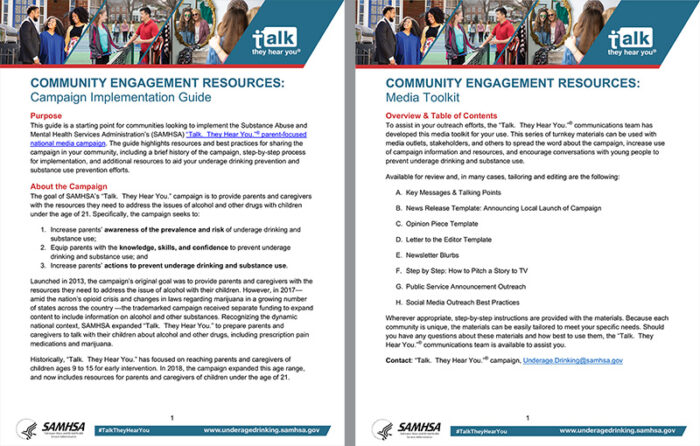
Community Engagement Resources
Various tools and documents that will support SUD providers with proper languages, media involvement, and overall techniques to use when engaging with the community.
Substance Misuse Prevention for Young Adults
This guide discusses effective prevention practices to mitigate risk factors associated with substance misuse and promote protective factors among: all young adults generally; young adults at significantly higher risk for substance misuse; and young adults who are not diagnosed with a SUD but are engaging in substance misuse.
Perinatal Substance Use: Family Toolkit
This booklet provides tools you need to be as healthy as you can be during pregnancy, whether or not you decide to stop using.
